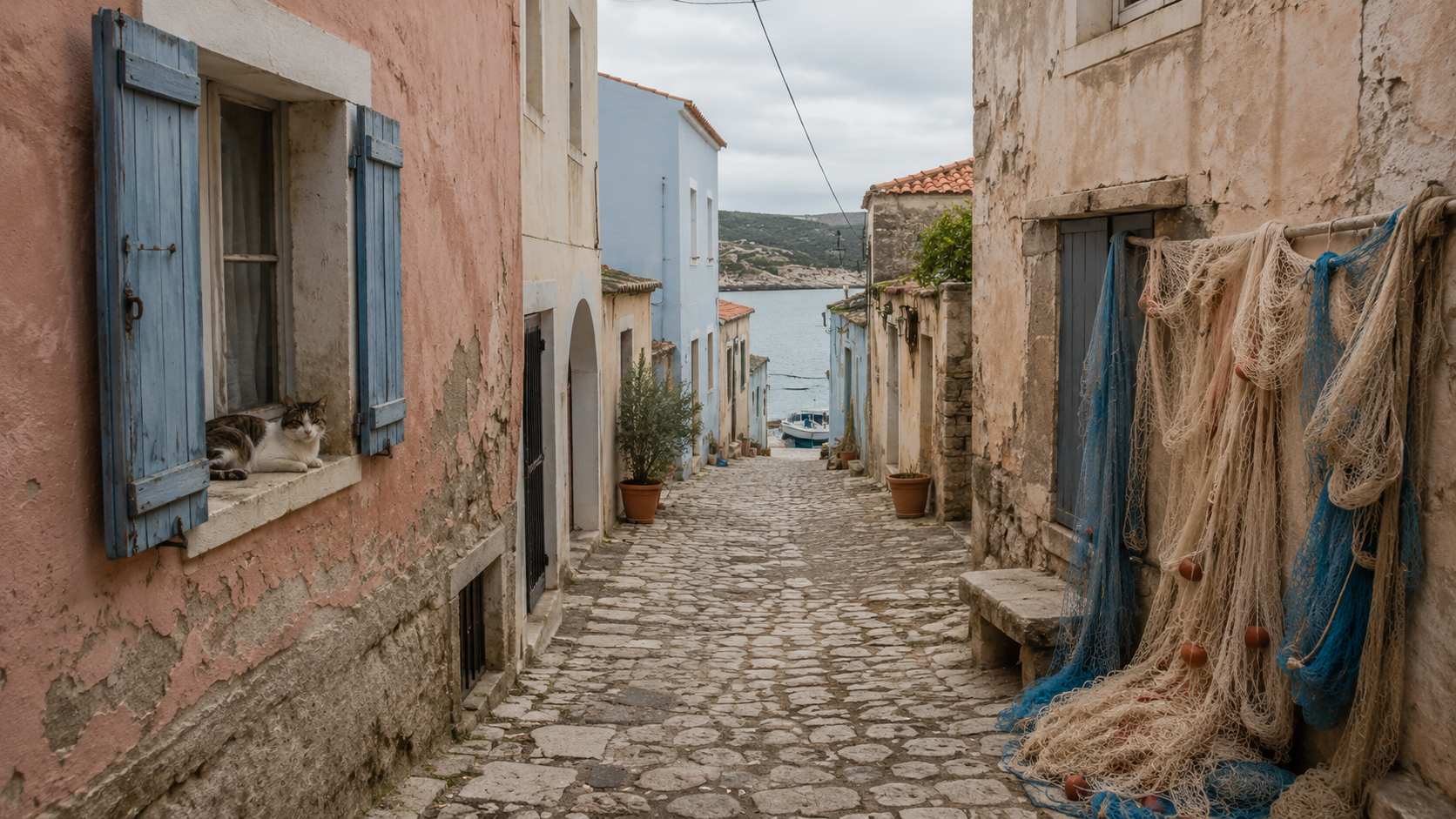
Every coastline has them. Small towns tucked into bays or perched on clifftops, where the rhythm of life still follows the tides rather than the tourist season. These are the places that sailing takes you to, because they are often only properly accessible from the water. The road, if one exists, is an afterthought. The harbour is the front door.
I have spent years collecting these towns the way other people collect stamps. Each one has a particular quality that is hard to define but impossible to mistake. It is the feeling of arriving somewhere that has not yet decided to perform for visitors. The cafe serves what it has always served. The fishermen mend their nets where they have always mended them. Nobody is trying to sell you anything.
The Dalmatian Coast's Quiet Side
Everyone knows Dubrovnik and Split, but the Croatian coast between them is dotted with towns that most tourists never reach. Ston, at the base of its medieval walls, still harvests salt the way it did in the fourteenth century. The oysters from Mali Ston Bay are legendary among those who know, and entirely unknown to those who do not. You can anchor in the bay, row ashore, and eat them at a table overlooking the water where they were raised.
Further north, the island of Vis was a Yugoslav military base until the 1990s, which kept it wonderfully undeveloped. Komiza, on the island's western side, is a fishing village that looks exactly as it did fifty years ago. As National Geographic's travel coverage has often highlighted, the most authentic destinations are frequently those that were accidentally preserved by history rather than intentionally marketed.
Portugal's Forgotten Algarve
The western Algarve, particularly the stretch between Lagos and Sagres, has resisted the development that consumed the eastern coast. Salema remains a genuine fishing village with a beach that happens to be spectacular. Burgau sits in a fold of cliff with a harbour that has barely changed in a century. These towns survive because the Atlantic swell that makes this coast magnificent also makes it challenging. The sailors who bother to round Cape St Vincent are rewarded with something increasingly rare in southern Europe: the real thing.
Japan's Coastal Time Capsules
The Seto Inland Sea is one of sailing's best-kept secrets. Between Honshu, Shikoku, and Kyushu lie hundreds of islands, many with fishing villages that operate as they have for generations. Tomonoura, on the mainland coast, has a harbour lined with Edo-period warehouses. The town was a waiting port for ships navigating the tidal currents of the inland sea, and that heritage is still written into every building. There are no chain restaurants, no souvenir shops designed for tourists. There is just a town that happens to be extraordinarily beautiful because it was built by people who understood the sea.
Finding Your Own Forgotten Town
The secret to finding these places is simple: look where the roads do not go. If a coastal town is difficult to reach by land but has a natural harbour, there is a good chance it has been left alone by the forces that homogenise everywhere else. Sail there, anchor quietly, go ashore with respect, and you will find a version of coastal life that most people assume no longer exists.
It does exist. You just have to arrive by the right door. And the right door is almost always the one that faces the sea.